New year cancer stories
Ever since my diagnosis with lymphoma last summer, I’ve tried to stay away from press coverage about cancer. This is because most of the time it’s pretty poorly reported and I’ve found it far more helpful to refer to the information provided by my consultant, specialist charities and peer-reviewed science. However, a couple of press stories have caught my attention over the holiday period.
The first of these was the reporting of Dr Richard Smith’s views on death, from a BMJ blog article published on new year’s eve. I’d encourage you to read the article, rather than some of the more hysterical press reports or twitterings that there’s been about it, as it puts his words into proper context. The main point he makes is that because death comes to us all, sooner or later, we need to come to terms with it. He suggests that (suicide excepted) there are four different types of death: sudden causes; the long slow death of dementia; death from organ failure and the weeks or months that those with terminal cancer have. He considers all four types and argues that a death from cancer is preferable, as at least you usually have the time to put your affairs in order and say goodbye to those you love.
Well, we’re all entitled to our opinions (although many of the comments on the article suggest that he isn’t entitled to his, which is ridiculous). I think that I’m minded to agree with him – but only up to a point. The one, very specific point that I do definitely disagree with is made in his final paragraph: “let’s stop wasting billions trying to cure cancer, potentially leaving us to die a much more horrible death.”
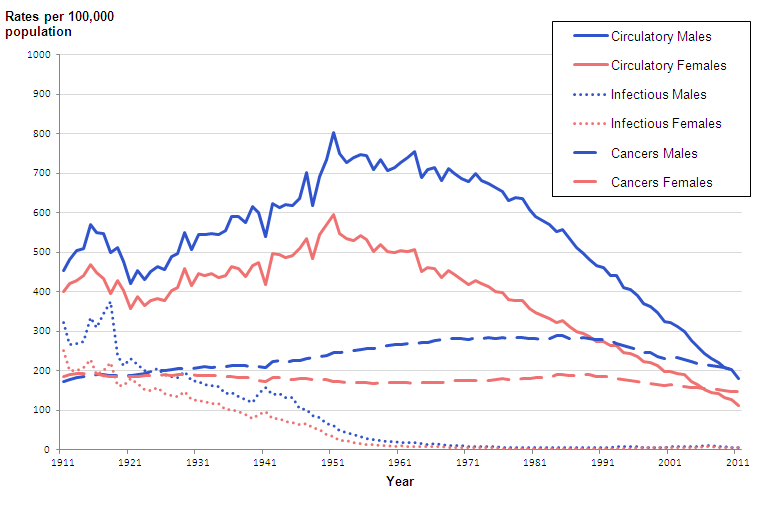
I don’t think that money spent on extending human life is a waste. It’s the focus on life and the good that we can do, rather than our inevitable death, that we ought to all concentrate on. There’s always an argument to be had about priorities and where the resources we have should be spent, but on a purely parochial (England and Wales) basis, it would seem to me that spending money on finding ways to address cancer still seems worthwhile, given the relative progress made over than last century in reducing death rates from other causes (and yes, I’m aware that if you don’t die of circulatory or infectious diseases, then more people will survive to die of cancer. We all have to die of something, so the chart below doesn’t quite tell the full story).
The ONS notes that advances in treatment for the other two main causes of mortality have “reduced the number of early adult deaths” – but that’s not necessarily the case for cancer, which can still strike us at any age. I suppose that my main argument with Dr Smith’s last statement is that money spent on cancer research most definitely isn’t a waste if it enables younger people to have the prospect of a longer, healthier life – in the same way that tackling other causes of early death wasn’t viewed as a waste of resources in the 20th century.
The second story has been about the role of “bad luck” – or more scientifically, the chance of a random cell mutation causing a cancer to occur, versus the contribution from lifestyle choices and inherited genes. I’m not convinced that the mainstream press (or me) has understood the subtitles of this research (this link takes you to the abstract and original paper) but there’s an interesting blog article and debate about it here.